You know that feeling.
It’s 4:47pm. The conference is winding down. Someone is already packing up the branded pull-up banners. You’ve been on your feet since 9am, you’ve said “so what do you do?” about thirty times, and your jacket pocket is heavy with cards.
Some of them are nice. Thick cardstock. Spot UV. One of them is gold-embossed and you genuinely respect the commitment.
You get home. You empty your pockets onto the table. And the cards sit there.
They sit there Saturday. They sit there Sunday. By Wednesday your partner has moved them to a drawer. By the following month you find one under the microwave and you cannot, for the life of you, remember whether this man was the fintech guy who wanted to talk integrations, or the other fintech guy who just wanted to talk.
Multiply that by every event you attended this year. That’s your network. Sitting in a drawer. Under a microwave. You’re not imagining it either, most business cards don’t survive the first week.
The problem isn’t the card. It’s what happens after the card.
Let’s be honest about what a business card actually does.
It transfers about eleven words of information from you to a stranger, and then it stops working. Forever. That’s the whole product.
It doesn’t tell you if the person ever looked at it. It doesn’t tell you if they visited your site afterwards. It doesn’t remind you to follow up. It doesn’t know that you met at TechFest and not at that other thing in Lekki. It doesn’t know anything, because it’s paper.
And here’s the part nobody says out loud: the exchange isn’t the hard part. The follow-up is.
You already know how to meet people. Nigerians are extremely good at meeting people. What kills the deal is the fourteen days between “great to meet you, let’s talk next week” and the moment you finally remember to send that message by which time the context is gone, the urgency is gone, and you’re sending “Hi, we met at the event” to someone who met two hundred people that day.
The relationship didn’t fail. The memory did.
Problem two: you are not one person
Look at your own week.
Monday you’re the founder. Tuesday you’re on someone’s advisory board. Wednesday you’re a consultant on a project that has nothing to do with either. Thursday you’re speaking on a panel about a completely different thing. Friday you’re pitching.
So which card do you hand out?
Most people solve this by carrying two or three different cards and doing a small mental calculation at the moment of the handshake. Which version of me is this person meeting? and then fumbling in the wrong pocket. Or they go digital, get a link that holds everything, and hand a venture capitalist a page that also lists their photography side business.
The first wave of digital business cards was supposed to fix this.. Most of them didn’t. They just moved the same static card onto a screen. One link. One version of you. Same rigidity, better resolution.
Your professional identity is contextual. Your tools should be too.
Problem three: nobody can prove any of it worked
This one is for the teams.
A company sends eight people to a conference. Flights. Hotel. Booth. Branded pens that cost more than they should. Four days of everybody’s time.
Someone eventually asks: what did we get from that?
And the honest answer is a shrug and a shoebox. Maybe someone typed a few names into a spreadsheet. Maybe a rep remembers a good conversation. But nobody can point to a number and say this event produced this pipeline, because the moment a card leaves your hand it leaves your data.
Marketing can measure a click on an Instagram ad down to the second. But a handshake the highest-intent interaction in business vanishes into thin air.
That’s the gap. Everything digital is measured. Everything physical is guessed at.
So, what is MyIdento?
Short version:
It’s the layer between the handshake and everything that happens after it.
Longer version, in plain English:
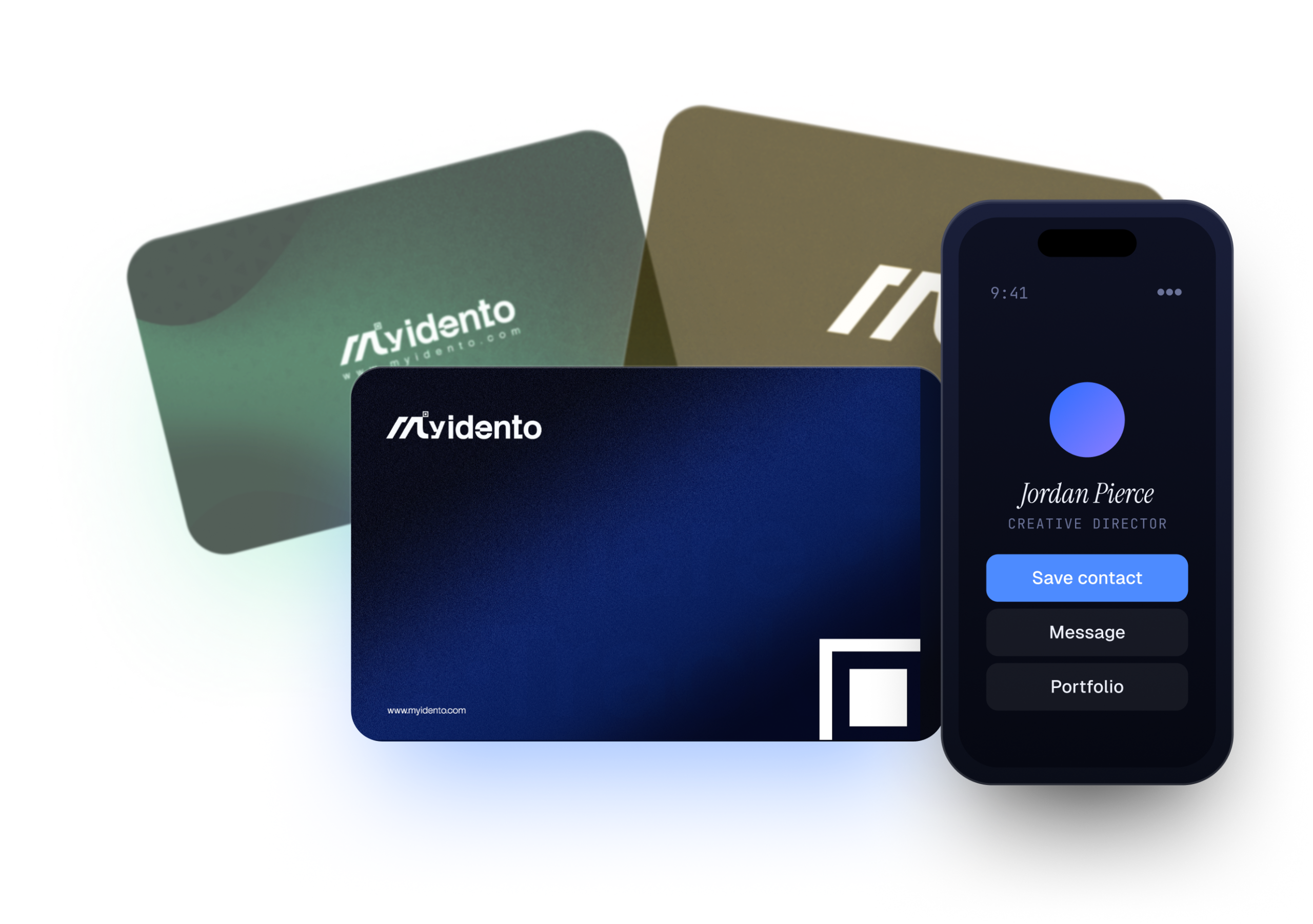
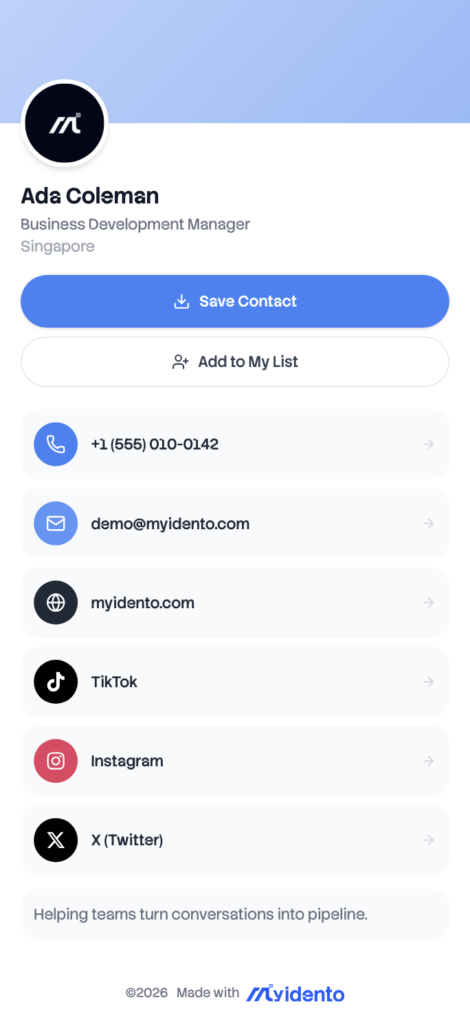
One card. Many yous. You get a physical card. Instead of it being permanently welded to one profile, you decide what it points to and you can change your mind. Founder profile for the pitch room in the morning. Consultant profile for the client briefing that afternoon. Same card. No new card, no reprint, no fumbling. You switch it in seconds.
Tap or scan, whatever the room supports. Some phones tap. Some people would rather scan a code. Both work. The point isn’t the technology it’s that the other person gets your profile in about two seconds without downloading anything.
You find out what happened next. Who opened your profile. What they clicked. Whether they saved your contact. How long they actually stayed. Which event they came from. The thing that used to disappear now shows up as data you can act on.
The follow-up writes itself. Right after a meeting still in the car park, still holding your keys you send a voice note to a WhatsApp or Telegram bot. “Just met Tunde from the logistics company, he’s looking at Q1 procurement, follow up Thursday.” That’s it. It gets parsed, structured, and filed against the right contact. No app. No login. No opening a laptop later that night, which let’s be serious you were never going to do.
Your contacts stop being a pile. Everything groups itself by where you met, what industry they’re in, which campaign or event brought them in. Two hundred contacts from a conference becomes something you can actually search.
And it points you at people you should know. Instead of waiting for you to scroll through a directory, it looks at what you do, who you’re connected to, and what you’re looking for and surfaces the people worth a conversation, with a reason attached.
For teams, all of it rolls up. Who’s actually generating pipeline, which event earned its budget, which leads got followed up and which ones went cold and it feeds straight into the CRM your sales team already lives in.
Who we built this for
- Sales and field teams who are tired of proving ROI on events with vibes and a spreadsheet.
- Founders, consultants, and everyone wearing four hats who need to show the right face to the right room without carrying a wallet full of cardboard.
- Event organisers and communities who want their attendees to actually connect, not just download an app once and never open it again.
The honest pitch
We’re not trying to make a prettier business card. There are enough of those, and frankly some of them are beautiful.
We’re saying the business card was never the point. The point is that you met someone, there was something there, and right now the entire system for capturing that moment is a piece of paper and your ability to remember things at 11pm on a Tuesday.
That’s a bad system. It’s been a bad system for a very long time.
So we built a better one.
MyIdento is live. Set up your first profile in under five minutes, and find out what actually happens after you hand someone your card.